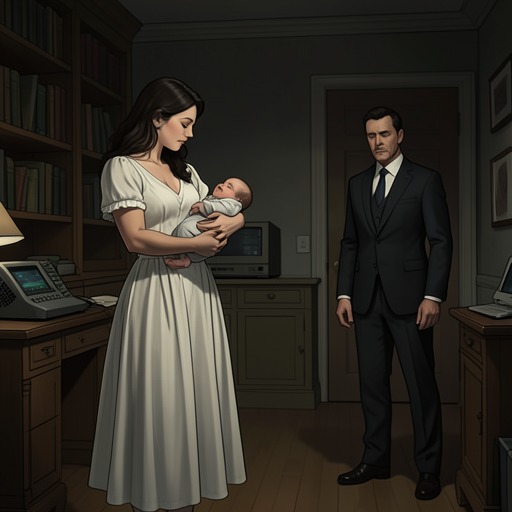
Maribel Arnaz
The Vampire Prince’s BrideMaribel Arnaz enters the vampire world not as a chosen heroine but as a woman cornered by debt, eviction, unemployment, and the theft of her identity. Her application to become a living blood donor begins as an act of economic survival; it later becomes the basis for her marriage to Sheridan and her transformation from disposable labor into a human wife and mother within vampire society.
Identity and Circumstances
Maribel’s introduction is deliberately grounded in vulnerability. Sitting across from a vampire during her donor interview, she is unnerved by the creature’s unblinking stare and briefly considers ending the meeting. She cannot simply return home, however, because she no longer has one. Six months after losing her job, she is being evicted, her car has been repossessed, and she carries half a million dollars in debt after her boyfriend stole her identity and spent money in Las Vegas. The banks have refused to solve the problem because she did not report the suspicious activity quickly enough. Her financial predicament leaves her with very few choices, while the vampire city offers a disturbing but practical alternative: humans can be paid to serve as living blood donors.
Maribel is candid about her motive. She applies for the position because of the money, including a monthly payment of ten thousand dollars, an additional payment for each ounce of blood consumed, and the possibility of becoming exclusive with a vampire. The arrangement is not merely medical. Patricia explains that being fed upon is often highly sexual and that sexualized feeding carries additional compensation. Maribel therefore enters a system in which her blood, body, and intimacy are all assigned monetary value. Her choice is neither simple consent nor simple coercion: she signs because the contract may allow her to pay student loans and the debt created through Phil’s fraud before her credit is ruined. The speed of her acceptance matters as well. She is approved because she is healthy, in her prime, and has a relatively uncommon blood type; before doubt can make her reconsider, the agreement is signed.
Entry into Vampire Society
The donor system initially defines Maribel as a resource. She is a human body placed within vampire walls because her blood is scarce and profitable. Yet the same qualities that make her economically desirable also make her personally significant to Sheridan. When he meets her, he tells her that he has carried her scent in his mind since she entered his palace and that he has been searching for a woman who could bear his child. His interest changes the terms of her existence. She is no longer merely a paid source of blood; she becomes the possible mother of a vampire king’s heir.
Maribel does not surrender all bargaining power when Sheridan proposes pregnancy. She meets his demand with a condition of her own: if she is to have his baby, he must marry her. Sheridan agrees without hesitation and even proposes the following day for the wedding. The exchange reveals Maribel’s practical intelligence. Marriage offers her more than romance; it gives legal and social protection, a position within the palace, and a counterweight to the unequal power between a human woman and a vampire king. Her strategy turns a reproductive demand into a negotiated relationship.
Her new position also exposes her to hostility. Phil arrives at the palace claiming that he has come to take her, but Sheridan refuses to accept his word over Maribel’s and insists on hearing her account first. The scene places Maribel’s former life and her new one in direct conflict: the man whose fraud produced her debt attempts to reclaim access to her, while Sheridan treats her testimony as decisive. Later, Sheridan explains that some vampires opposed his marriage to a human, although her presence has caused several of those opponents to support his decision. Maribel thus becomes both a target of anti-human sentiment and an instrument through which the palace’s political attitudes begin to shift.
Marriage, Pregnancy, and Bodily Agency
Maribel’s marriage to Sheridan is marked by an unusual separation between public status and physical intimacy. Although they are married, Sheridan has not yet marked her, drunk from her, or made love to her. He explains that this delay makes pregnancy more difficult, and Maribel herself asks him to mark her when she worries that she is not conceiving. Instead of answering with a ritual of possession, Sheridan kisses her and reveals that she is already pregnant. The disclosure reverses her understanding of the marriage: what she feared was reproductive failure has already become a hidden success.
The pregnancy is not presented as an abstract royal duty. It is repeatedly connected to Maribel’s body and to her ability to negotiate what happens to it. She entered the palace after agreeing to bear Sheridan’s child, but she also demanded marriage before proceeding. The resulting arrangement retains the language of transaction while developing into a personal bond. Her body remains central to vampire reproduction and political legitimacy, yet Maribel is not silent within that process. She asks for terms, receives information late, and reacts with shock when the pregnancy is confirmed; the narrative gives her decisions and responses visible weight rather than treating her solely as a vessel.
Their physical relationship eventually begins after the pregnancy has already been recognized. During their first fully described sexual encounter, Maribel takes an active role, setting the rhythm before Sheridan rolls them over and continues. The scene’s emphasis on her initiative contrasts with the earlier donor arrangement, in which her body was measured in blood and payment. Here, physical intimacy is still connected to the vampire world’s reproductive and sexual customs, but Maribel is shown directing part of the encounter and participating in pleasure rather than being reduced to an object of consumption.
Motherhood and New Belonging
Maribel gives birth to a daughter, and the birth completes the transformation begun by her application to the donor program. Sheridan learns of the delivery from the midwife through the announcement that his daughter has been born, and he responds with immediate delight. The child makes Maribel’s place in the palace concrete: she is no longer only a donor, a prospective bride, or a human political symbol, but the mother of the king’s daughter.
The first domestic scene after the birth complicates the apparent security of that new status. Maribel nurses the baby, who latches eagerly, while Sheridan marvels at how naturally the infant knows what to do. Maribel answers with anxiety about her own competence. Despite attending parenting classes, she worries that she will do something wrong and admits that she has never even babysat. Her concern gives motherhood a human scale that contrasts with the grand political implications of producing a royal child. The daughter may strengthen Sheridan’s position and challenge anti-human factions, but Maribel experiences the change primarily as responsibility.
Narrative Significance
Maribel’s arc is built around the conversion of exchange into relationship. At first, money buys access to her blood because she is economically desperate; then reproduction is proposed as a benefit of her body; finally, marriage and parenthood create a household that cannot be understood only through the original contract. Her story does not erase the unequal structures surrounding her. The donor economy still treats human blood as a commodity, vampires still possess social and physical power over humans, and her pregnancy is initially demanded by a king. What changes is Maribel’s position within those structures. She negotiates marriage, confronts the return of the man who exploited her, survives opposition to the human-vampire union, and becomes the mother of a vampire king’s daughter.
The character also embodies the book’s recurring instability of boundaries between human and nonhuman life. Elsewhere, the narrative presents technological bodies, altered species, cross-species pregnancy, and inherited biological change: Sara uses bionic eyes that can conceal stun grenades; Lisa’s pregnancy is examined through a three-dimensional holographic scan; Shay explains that Stlozyn ancestors were taken from Earth and genetically altered until their bodies became a distinct subspecies. Maribel’s story approaches the same question through blood, reproduction, and marriage rather than machinery or genetic explanation. Her human identity is not erased by entry into vampire society. Instead, it becomes the contested basis of a new family and a challenge to the assumption that human and vampire lives must remain separate.
Maribel’s decisive achievement is therefore not simply surviving poverty or marrying Sheridan. It is the reclamation of choice inside systems that initially price her body for others’ purposes. She begins by signing a contract because she has no home and almost no financial alternatives; she ends as a wife and mother whose presence changes the palace around her. Her daughter’s birth gives that change its clearest form: the human donor has become the founder of a royal human-vampire household.